The easy way to think of Xiaomi is as a Chinese smartphone maker which mimics Apple’s designs. But that would be wrong. It’s a narrative that was enunciated by Apple’s head of design Jonathan Ive, who when asked about the company last October was blunt: he “didn’t see [the similarities in design] as flattery” and called the superficial similarity in appearance of Xiaomi’s phones and software “theft” and “lazy”.

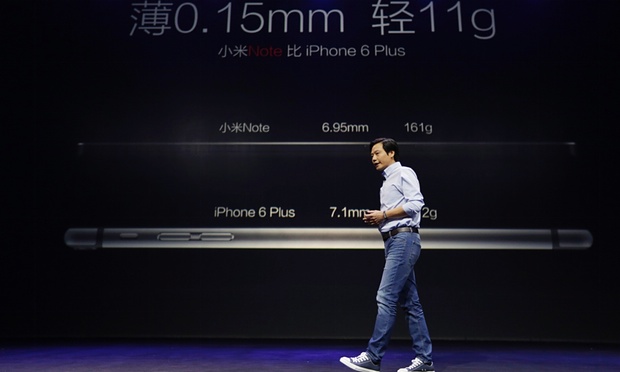
Some might instead think it’s a startup that aims to undermine Samsung, previously the sales leader in China, by offering phones with the same specifications as the South Korean giant, but at lower prices. Certainly it has mimicked some of its names: one of the new phones unveiled on Wednesday, a 5.7in device called the “Mi Note”, echoes the 5.7in Galaxy Note phablet range.

Both lines of thinking miss what keener observers believe is Xiaomi’s true character, and its ambition: to become China’s biggest provider of internet-connected devices to an eager, ever loyal, following drawn from a young demographic numbering hundreds of millions who will soon be outfitting their first homes – and looking for a brand to help furnish it.
Furthermore, it could be ideally placed to do what neither Apple nor Samsung can: become the first company of the smartphone age able to shift into and control the next era – the “internet of things” age, when all sorts of items around the home and elsewhere have internet connectivity.
Xiaomi staff and users of Xiaomi phones react at the launch ceremony of the Mi Note in Beijing January 15, 2015.
Neither the company’s chief executive/founder Leu Jun, nor any of its pronouncements, have expounded that strategy. Yet it’s clear that it must have had a persuasive story to lure Hugo Barra away from head of product management for Android inside Google in mid-2013 to spearhead its international expansion. Barra’s interviews, however, haven’t said anything about longer-term strategy; only that he saw “a dream job, this idea of building a global company which could be as significant as Google, from the ground up.” He suggested in September 2013 that it would aim to sell its phones nearly at cost, and profit on services – but which services is unspecified.

Most people outside China, or away from the tech mainstream, haven’t heard of Xiaomi. Even the pronunciation can be a challenge; try replacing the “er” sound in “shower” with “me” (that is, “sh-ow-me”). In China, though, Jun has almost rockstar status, product unveilings are shrouded in mystery and rumours – before the latest phones were released, some suggested (wrongly) they would have expensive sapphire screens – and thousands of excited fans pack the venues.
However, if Xiaomi were just another smartphone company, even a popular one in the world’s biggest phone market, that wouldn’t really justify the $45bn valuation it attracted in late December when it raised $1.1bn in venture funding. Handset makers generally struggle to make profit, even in China where hardly any use Google’s services, instead using the open-source Android Open Source Platform (AOSP) and offer (and monetise) their own maps, search and app download services.
As a phone company, it’s thriving: Jun founded Xiaomi in 2010, having already had success as chief executive at software maker Kingsoft, Joyo (which he sold to Amazon for $75m in August 2004), and as chairman of browser maker UCWeb.
Xiaomi’s revenues have doubled each year, and it ended 2014 having shipped 61m smartphones – more, that is, than the entire Windows Phone ecosystem, where about 50m were shipped. In all, 97% of Xiaomi’s phones were sold in China, with a few in India and the rest of Asia.

So what’s special about it? The first clear clues emerged with a study in January 2014 by analytics company Flurry, which found Xiaomi users spend more time on their devices than those of any other brand – including Apple’s iPhone. For every 100 minutes iPhone users spent in apps, Xiaomi users spent 107; for Samsung users the figure was 86, for HTC users 73, and averaged across other Android devices it was 71. That means Xiaomi users spent 50% more time on their phones than non-brand Android users.
Xiaomi users are younger than average and more likely to be using their phone for business use.
Flurry dug deeper and found another key difference: compared to the average smartphone owner, those on Xiaomi were much more likely to be aged between 18 and 34, and much less likely to be aged over 35. They’re also more than twice as likely as the average to be business professionals (rather than parents, fitness nuts or gamers), probably from university – a demographic expanding by about seven million every year, and by 2020 will number 195 million just in China, more than is forecast for the entire US workforce.
All this points to the key appeal and enormous potential of the company, says Ben Thompson, who has worked at both Microsoft and Apple, and now runs his own blog – Stratechery – and consultancy.
Thompson lives in Taiwan, where he is able to observe the particular social and practical nuances of the fast-moving smartphone and internet market in Asia at ground level – unlike many commentators in the west, who see only the surface sheen of Xiaomi’s products.
Earlier this month, Thompson outlined on his blog how he sees Xiaomi’s ambition playing out. Because most of the target demographic will still be living with their parents, even at 24 (renting is “frowned upon”, he says), they have disposable cash; they also have a desire to build their own lifestyle that differs from their parents. Unlike their parents, the upcoming demographic will value home-grown brands.
And when the time comes to leave home, Thompson explains, those Xiaomi fans “will need to buy TVs and air purifiers and all kinds of (relatively) high renminbi [price] goods. And which brand do you think they will choose?”
They can already choose an Xiaomi air purifier, smart TV, tablet, Wi-Fi router, Wi-Fi dongle and fitness band; as of Thursday, there will also be headphones and a tiny TV set-top box the size of an iPad charger with Chromecast-like functions. Can a watch be far behind? The company has invested in iHealth, a healthcare device maker with offices in the US and China, and in other companies that make mobile payments systems, Wi-Fi LED bulbs, and portable chargers. In the future, might there be Xiaomi-linked washing machines, dishwashers, door locks? It’s not inconceivable.

But how does that put it ahead of Apple or Samsung, where the latter has announced a $100m fund to develop its “internet of things” (IoT) strategy, and Apple has offered HomeKit, a platform for connecting IoT devices to iOS?
In that, Xiaomi’s advantage is that it doesn’t have any of what Benedict Evans, an analyst at venture capital company Andreessen Horowitz, calls “technical debt”. Writing on his blog this week, he noted that Apple and Google (with Android) overcame the incumbents, Nokia and BlackBerry, because they could build devices using technologies – big touchscreens, fast mobile networks – that would have sunk them in 2000, but led to success after 2007.
Xiaomi chairman Lei Jun in front of the company’s logo.
Could it be that Xiaomi is also free of the original assumptions of smartphone builders, and can be the first IoT company? Thompson thinks so: “you could argue that Xiaomi is actually the first “internet of things” company: unlike Google (Nest), Apple (HomeKit), or even Samsung (SmartThings), all of whom are offering some sort of open software development kit to tie everything together (a necessity given that most of their customers already have appliances that won’t be replaced anytime soon), Xiaomi is integrating everything itself and selling everything one needs on Mi.com to a fan base primed to outfit their homes for the very first time,” he writes.
After watching the latest product unveiling, Thompson noted in his subscriber-only email that the introduction of the two top-end phones – priced notably higher than any previous Xiaomi models – were a surprise. But, he realised, it’s just a refinement of its aims: just like any company, it wants to build a “moat” – a unique selling point that protects it from would-be rivals undercutting or displacing it.
“It’s a classic strategy,” Thompson noted: “bring someone in on the low end and gradually lever them up into higher priced – and higher margin – segments. It also makes sense; it perhaps turns out that Xiaomi is, in the end, first and foremost a phone company, just one that is trying to build an actual moat around an Android-based operating system.”
In that way, Xiaomi isn’t copying anyone; it’s striking out on its own, an insurgent in the mobile phone space with an eye on a future that older companies might not be able to follow it into. That could make it easily worth its huge valuation.

 Coming to the leaked specifications, the Mi Mix 2 is expected to be powered
by the Qualcomm Snapdragon 835 processor, 6GB RAM and up to 256GB of internal
storage. It will come with an AMOLED display and a 4,500mAh battery.
Coming to the leaked specifications, the Mi Mix 2 is expected to be powered
by the Qualcomm Snapdragon 835 processor, 6GB RAM and up to 256GB of internal
storage. It will come with an AMOLED display and a 4,500mAh battery.